Tuesday, 19 June 2012

Buffett's Most Realiable Indicator ... Not For Us

Buffett has said before that the total market cap vs. GNP is one of his preferred valuation metrics. The current reading of 89% is still above his preferred buying range (70-80%), but well off the highs we've seen in the last 15 years. Buffett has previously explained his thinking behind the indicator:

"For me, the message of that chart is this: If the percentage relationship falls to the 70% or 80% area, buying stocks is likely to work very well for you. If the ratio approaches 200%-as it did in 1999 and a part of 2000- you are playing with fire."
So stocks aren't cheap, but they're also not terribly expensive based on this measure. If the recent trend holds we could be nearing Buffett's preferred buying range in the coming years….
(click to enlarge)
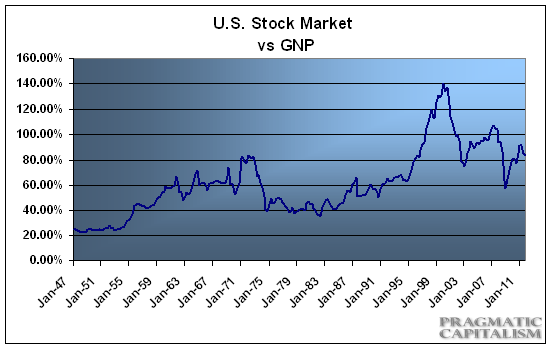


Yes, its a good indicator, but a very basic indicator akin to above or below NTA. If you are buying below 100%, you are "safer", its not rocket science. This indicator ranges from 60%-140% of GNP owing to the US economic structure.


One has to bear in mind that the market cap vs GNP relationship is very different for other countries.


One of my favoured economist, Chua Hak Bin, wrote on the same topic some time back, with an Asian flavour:


Malaysian Economy More Sensitive to Crashes
The Malaysian economy is however more sensitive to crashes. The representation of households who own shares directly or indirectly is probably similar to the U.S. profile. The market capitalisation of the KLSE is however about 320 percent of GNP. This implies that a 30 percent crash in the KLSE amounts to the equivalent wipe-out of 96 percent of GNP. If the stock of wealth is about 10 times GNP, this still amounts to a dissappearance of about 10 percent of total wealth. Such a sharp fall in wealth will inevitably hurt consumer spending.


The Malaysian economy's sensitivity to stockmarket crashes has been increasing over time with the rising market capitalisation of the KLSE. During the 1987 crash, Malaysia's stockmarket capitalisation accounted for only about 90 percent of GNP. As such, the ripple effects from the 1987 crash did not have such far reaching consequences. However, with the capitalisation accounting for more than 300 percent, Wall Street's sentiment may have become inevitably linked to the Malaysian economy. This worrisome conclusion extends to Hong Kong and Singapore whose market capitalisation have both exceeded 250 percent as well.


TABLE: THE MALAYSIAN ECONOMY IS OVEREXPOSED TO A STOCKMARKET CRASH

Countries
 
Market Cap/ GNP (%)
Fall in Value from 30%
Crash as Percent of GNP

Malaysia
320
96
Hong Kong
290
87
Singapore
250
75
Bangkok
109
33
London
105
30
New York
70
21
Bombay
38
11
Jakarta
35
10


Some Comforting Thoughts
There are some important factors to account for when linking market capitalisation to total wealth. First, the rather high market capitalisation of the Kuala Lumpur, Singapore and Hong Kong stockmarkets are partly a result of its openness to foreign investors. As such, a large fraction of the market capitalisation is "foreign wealth" rather than "domestic wealth." The fraction will be higher in Singapore and Hong Kong than Malaysia. If the fraction of Malaysian shares which are foreign-held account for as much as 30 percent, then the true "domestic market-capitalisation to GNP" that matters for calculating the local "wealth effect" is reduced to only 224 percent.


Second, consumption is dependent on permanent rather than current wealth. Consumers take into account their future income when deciding on their habits today. If the fall in the stockmarket is regarded as temporary rather than permanent, consumers will not treat the loss as a real loss but a temporary paper loss. As a result, consumers will not reduce their spending as sharply when faced with the fall in current wealth. A word of caution is noted however as empirical studies have provided evidence that consumption is linked to current rather than permanent wealth due to the existence of credit constraints.


My Comments: It is not the Asian markets openness that causes the 300% market cap vs GNP, or anything to do with foreign investments. Rather, its the listing mentality of the respective countries coupled with the "designed rules". In Malaysia, once you start making RM3m-5m a year, there will be predators coming to you thinking of ways to list your company.


This makes for a much lower threshold to list companies in Asia (generally) than elsewhere. Hence you may generalise that the only things not listed in Malaysia are the mamaks and mechanics (though some of the  bigger mamak chains make quite decent bucket loads of money, but then they have to worry about paying real taxes if they were to list them properly). 


Of course we can still use the market cap vs GNP indicator for the Malaysian market alone, maybe the range over a 20 year period could be between 200% to 400%, and you surmise that anything below 300% might be a "safer" buying territory. To me, its still more b.s. than anything.


Hence we can also surmise that a market correction of 25% in the US and a similar 25% correction in Malaysian, Singaporean and HK markets are very different. The latter 3 countries will see a more pronounced real money flow effects (shrinkage and reduced velocity of money). In most of Europe the normal indicator is around 50%, which is to say a market correction has less real impact on the real economy as a large portion of the economy there are still not listed.


That indicator is shallow and does not relate or take into account the dynamics of the markets. For example, you can tally up the holdings of indexed stocks in Malaysia held by local funds, esp local government or GLC funds. Without the exact data, I can say it has been a substantial rise over the past 10 years, in particular over the last 5 years. 


What that means may be that the index could be easier to "control". This will also mean that you may be able to "engineer better" a stock market sell down, or the reverse as well. Just think how well you could "control the index" if you hold 25% of all indexed stocks, what if its 35% or 45%, maybe 65% later on.


The amount of local funds have been mushrooming and EPF has really no space to put it anymore, which is why they have to think of overseas. The other local funds have also been growing as well. Its all good  and well if it does not get to the level whereby there is more "manipulative streaks" than a genuine "investing strategy for better returns". The bigger danger is that if you hold a strong hand, you could also close a stock price "artificially higher every year end" to maintain the appearance of good performance for your overall funds, even though in reality the fundamental performance of the said stock may be not exciting.


The powers to be has to be fully aware of the potential distortion this may bring and prevent this scenario from ever occurring. We are not there yet, but we need to be on guard owing to rise in investible funds in our country.

Monday, 18 June 2012

IHH, This One Is Fairer


Malaysia is the third-most-active venue for the IPOs globally this year after Felda's offering, up from 20th place at this time last year. IPOs on the Bursa Malaysia have raised $3.45 billion already, according to data provider Dealogic. A successful offering by IHH will only further strengthen Malaysia's standing in the global IPO market this year.

Despite the resounding 'success' of FGV, the book building among foreign institutions have been naturally disappointing. Many got less than 1% of what they actually bidded for. Both these big IPOs went for the cornerstone strategy, which requires pricing it well since they will be locking up for 6 months. Little for foreign institutions meant that market prices will move up as investors top up their holdings.


Bear in mind, the real market price is 6 months later when the lock up expires.


Elsewhere in the region, companies have been either delaying and cancelling their IPOs on worries about the euro-zone debt crisis and souring investment sentiment. In Singapore a $2.5 billion deal by motor-sport franchise Formula One Group was delayed earlier this month, while a $1 billion Hong Kong IPO by U.K.-based jeweler Graff Diamond Corp. was pulled.


Kuwait Investment Authority (KIA) will invest about US$150 million (RM477.8 million) in Malaysian firm IHH Healthcare’s planned US$2 billion (RM6.4 billion) IPO in Kuala Lumpur and Singapore. The investment is poised to make KIA the second-biggest investor in the Malaysian healthcare firm’s IPO. It will be the fund’s biggest investment in an Asian flotation since it poured US$800 million (RM2.5 billion) into Agricultural Bank of China’s US$21 billion (RM66.9 billion) offering in 2010.


With a heavy reliance on cornerstone investors and domestic demand, Malaysia has bucked the dismal IPO trend in other markets such as Singapore, where motor racing firm Formula One decided to delay its near US$3 billion (RM9.6 billion) offering due to volatile markets. In the latest blow to Asian deals, soccer club Manchester United also ditched its plans for an Asian stock market flotation and is preparing to list in the United States.

Cornerstone investors back many Asian listings, committing to buy large, guaranteed stakes and agreeing to a lock-up period during which they will not sell their shares.


KIA, which manages US$280 billion (RM891.4 billion) in assets, invests in big-ticket IPOs, but has been lately keeping its powder dry amid volatile markets. Malaysia pension fund EPF will separately invest about US$200 million (RM636.7 million) in the IHH IPO, making it the biggest investor in the deal, said the sources, who could not be named because the details of the deal are not public.


The IHH IPO is expected to be priced in the second week of July and the listing is scheduled in the week starting July 23, according to a term sheet. IHH this week already locked in BlackRock Inc, Capital Group and Och-Ziff Capital Management Group as cornerstone investors for its dual listing. The board of International Finance Corp (IFC), the financial arm of the World Bank, has also approved a proposal to become a cornerstone investor in IHH’s offering.


Finance Asia: Malaysia-based hospital operator IHH is looking to raise up to $2.2 billion but, excluding the cornerstones, only $280 million will be available for institutional investors.

Perhaps it is the fact that the company is operating in the healthcare industry that makes it so prudent, but IHH Healthcare, which is backed by state-owned Malaysian investment company Khazanah Internasional, is certainly taking no chances with its initial public offering.


In addition to the 15% of the offering that has already been set aside for Bumiputera, or ethnic Malay investors, the company has secured commitments from 22 cornerstone investors that will buy 57.7% of the deal.


In terms of the number of cornerstones, this may well be a record in Asia, but perhaps even more noteworthy is the quality of the accounts. The line-up comprises 12 international accounts, including three sovereign wealth funds and the International Finance Corp, as well as 10 Malaysian entities. A couple of the cornerstones were shareholders in Parkway and Pantai before these two units were taken private by IHH and delisted from the Bursa Malaysia and the Singapore Exchange in 2007 and 2010 respectively.


Another 14.6% has been earmarked for retail investors in Malaysia and Singapore, as well as directors and employees of the group, which means that only about 12.8% of the offering will be available to institutions through the bookbuilding that will kick off in early July.

Based on the earlier announced maximum price of M$2.85 per share and the announcement on Friday that IHH will sell up to 2.4 billion shares, including a 7.6% greenshoe, the deal could raise up to M$6.85 billion ($2.2 billion). But after taking away the other tranches, there will be only about $280 million worth of shares for international and non-Bumi Malaysian institutions combined. And that includes the greenshoe. Excluding the shoe, the institutional tranche will amount to only $124 million. Given the scarcity of shares, though, it is highly likely that the greenshoe will be exercised.


One could argue that the bookrunners may have gone a bit overboard by leaving so few shares for non-cornerstone institutions, but sources say the presence of so many high-profile cornerstones will help to validate the valuation, which involves quite a lot of assumptions about the growth in the next few years.


IHH currently has more than 4,900 beds divided on 30 hospitals as well as medical centres, clinics and other healthcare businesses across eight countries in Asia, the Middle East and Eastern Europe. Most of the beds are located in Malaysia, Singapore and Turkey — countries that the company refers to as its “home markets”. However, it will add a further 3,300 beds in the next five years, including the new Mt Elizabeth Novena hospital in Singapore, which is scheduled to open next month and will add about 333 beds by the end of 2013. The growth will come from new hospital developments as well as expansion of its existing facilities.

Importantly, the company has already paid about 75% of the capital expenditures for the new beds being added in the next five years, which means the ramp-up should have a significant impact on earnings.


Because of IHH’s many different businesses — apart from its core operations in Malaysia, Singapore and Turkey it also holds a 36% stake in Singapore-listed Parkway Real Estate Investment Trust (Reit) and an 11.2% stake in India-listed Apollo Hospital — and the lack of current earnings contributions from Mount Elizabeth Novena, analysts are using a discounted cash flow (DCF) and sum-of-parts-based methodology to value the company. DCF allows them to capture the strong cash-flow generation of the sector, as well as its defensive nature and structural growth prospects, but with the DCF assumptions being different for different countries, it does take some work to understand the valuation.


Syndicate analysts argue that the fair equity value for the company based on these calculations is about $8 billion to $10.5 billion, while the maximum price per share translates into an equity value of about $8.8 billion. The latter implies a 2013 enterprise value-to-Ebitda multiple of 16 times, which looks rich compare to other regional hospital operators like Singapore-listed Raffles Medical Group, Bangkok-listed Bangkok Dusit and India’s Apollo, which trade at about 13 to 14 times.


However, if you remove Mt Elizabeth Novena from the calculation, since it has yet to contribute any revenues, IHH’s EV/Ebitda multiple drops to about 11 times, according to a source. Analysts argue that IHH should trade at a premium to comps, however, due to its greater scale (versus other Asian operators) and stronger growth prospects (versus its US and Australian peers). Investors will have to get their heads around these numbers and in that context it should be helful that 22 cornerstones have already given their okay.


It is perhaps also lucky that the IPO process is so drawn out, as it will allow investors more time-than-usual to work on the numbers. The reason for the lengthy process is that the company is seeking to list in both Kuala Lumpur and Singapore, which means it will have to adhere to the rules related to prospectus exposures in both countries. Initially it will only offer shares to retail investors in Singapore, while the shares sold to institutional investors will all be listed in KL, but in terms of the timetable that makes no difference.

The company started investor education on June 8 and kicked off the management roadshow last Friday. However, the institutional order books will only be open from July 4 to 12. The pricing will follow shortly thereafter, while the trading debut is scheduled for July 28.


IHH is selling approximately 2.235 billion shares as part of the base offering, of which 1.8 billion are new. The remaining 434.7 million shares are secondary paper that will be sold by Abraaj Capital, the former owner of the Acibadem hospital in Turkey which got paid partly in shares when IHH acquired the business. Abraaj will sell its entire stake through the IPO.


In addition to that, there is a greenshoe of 169.4 million secondary shares that will be sold by Khazanah.


Including the shoe, the offering will account for 30% of IHH’s enlarged share capital. After the IPO, Khazanah will hold about 46%, while Japan’s Mitsui group will own 21% and the chairman of Acibadem Group about 3%.


The price range will be set just before the start of the bookbuilding, so the final proceeds have yet to be determined. But according to the preliminary prospectus, IHH will use 90.9% of the money raised to repay bank borrowings. A source said that this will reduce the company’s net debt-to-Ebitda ratio to about one time from five times based on 2012 numbers, which should put it in a good position to finance its future growth and to acquire additional assets. 


One of the key buying arguments is scale. IHH will be the second-largest listed hospital operator in the world after HCA in the US and the largest in the high-growth emerging markets. It will be about twice the size of Bangkok Dusit, which is currently the largest hospital operator in Asia with a market cap of just under $450 million. The other companies in the sector are significantly smaller and, according to a source, the seven largest listed hospital operators in Asia have a combined daily turnover of only about $45 million.

The hospital sector is also quite defensive with visible earnings and predictable cash-flow generation. Healthcare spending is underpinned by rising GDP per capita, rising affluence and ageing population, and one syndicate research report noted that the growth of hospital beds has lagged the population growth in IHH’s home markets, which has resulted in a supply shortfall. This is helping to spur a migration to private-sector hospitals. Another growth driver is medical tourism, which is not only contributing to an increase in admissions, but is also pushing up margins.


The prospectus doesn’t provide a breakdown of how much each of the cornerstone investors are buying, except to note that Malaysia’s Employee Provident Fund Board is taking 200 million shares, or about 8.95% of the total offering (pre-shoe), and the Kuwait Investment Authority is buying 150 million shares, or 6.7% of the deal.


The other cornerstones are AIA Group, Blackrock Investment Management, Capital Group International, Capital Research Global Investors, CIMB-Principal Asset Management, CMY Capital Markets, Eastspring Investments, Fullerton Fund Management (a unit of Temasek), The Government of Singapore Investment Corp (GIC), HPL Investers and Como Holdings, Hwang Investment Management, International Finance Corp, JF Asset Management, Keck Seng (Malaysia) and Keck Seng (Hong Kong), Kencana Capital, Lembaga Tabung Haji, Mezzanine Equities, Newton Investment Management, Och-Ziff Capital Management Group, and Permodalan Nasional Berhad (BNP).


Bank of America Merrill Lynch, CIMB and Deutsche Bank are global coordinators and bookrunners. Credit Suisse, DBS, and Goldman Sachs are joint bookrunners.


Saturday, 16 June 2012

Peut-etre Le Best Breadmaker In The Country ....


Pardon my attempt at basic French, went for a nice and easy Saturday morning hunt for the bread maker that has been given rave reviews by some of my friends. So it is with guarded expectations and muted anticipation that me and my special friend went searching for this little gem. We were not disappointed.


Its a tiny place but from what I know, they already have established a solid reputation and is supplying excellent breads to many restaurants and luxury hotels. We tried two of their four most popular breads for sandwiches, very good to excellent. A warning, their portions are generous to a tee.


The story goes that Tommy went backpacking to France but stayed on for years to learn how to make bread, so romantic, passionate ... how not to fall in love with his products.


http://tommylebaker.blogspot.com/


To get a full sense of Tommy's vision, passion and motivation, let him speak for himself:


"My passion for baking and the desire to revive the traditional values of craftsmanship in bread-making are the qualities that drive the essential spirit behind “Tommy Le Baker”.

My offerings are carefully made to restore bread-making to the highest standards of the craft. And more importantly, to recapture the original flavours sought by masters of the tradition.

Kneaded, shaped and baked on-site: the specially selected ingredients, time-tested methods, and unmistakable oven-baked freshness of Tommy Le Baker make every slice, loaf or piece of pastry truly a rare indulgence.

Modern means of production, managed with heartfelt care for the final outcome on a fussy selection of flours, grains, seeds, butters and oils allow me and my artisans to offer you the best kinds of fresh bread likely to be found anywhere in Kuala Lumpur.


In addition, where ever possible, I have been absolutely faithful to traditional recipes, while looking to support our local merchandisers and produce.

In the culmination of my time-tested methods, the finest ingredients, and a desire to produce only the best you may find in my bakery-café traditional favourites from artisanal viennoisseries, pâtisseries, gateaux de voyage, to even long-forgotten French regional specialities.

Come sit for a while here in my little bakery, surrounded by a plethora of the baker’s paraphernalia and instruments of his craft, and imbibe the sights, smells and tastes of the art of baking.

Here, you may enjoy fine coffees, popular soft drinks, and the occasional soup servings to accompany breads and pastries fresh out of Tommy Le Baker’s ovens.

Through my modest bakery, I hope you will join with me in my passion for good things, especially our breads: a significant part of culinary history that has brought joy, nutrition and life to mankind since time immemorial."


The lemon tart, which was raved by many, to me was good but not mind blowingly so. Still its a pretty good tart, 8/10. Should try. We tried their house cake, the La Joncha, or the Mona Lisa, it is simply possibly the best cake both of us have ever tasted. Its layered, it may not look like much but its divine. Each of the layers presented different textures to the whole cake and yet somehow each contributed exquisitely to the whole experience. There is the soft cream, the ice cream smooth moose, the delectable rich chocolate holding the whole cake together ... its just a wonderful cake experience. I am not exaggerating if I say this is 10/10 for a cake.


Love the guy, he is affable, personable, genuine, and you can feel his passion emanating through what he does. Love his mum too. Nice touch at the end, a personal hand written receipt, it kind of signs off on a lovely lazy afternoon, ... I am a happy boy!


Tommy Le Baker: Specializes in pre-ferments and long fermentation process to nurture the taste and to achieve the full nutritional potential of bread using what the nature has provided to his baker.
Address
B-0-7 Viva Residency,
378, Jalan Ipoh
(Opposite KLPAC)

Tel (03) 40432546

Opening hours
Tues - Fri, 10am - 8pm
Saturday, Sunday, Public Holiday , 10am - 6pm
Close on Monday


Friday, 15 June 2012

You Say That You Love Me ......

Found an exquisite poem, probably in Turkish, author unknown.


KorkuyorumI am Afraid

Yağmuru seviyorum diyorsun, 
yağmur yağınca şemsiyeni açıyorsun... 
Güneşi seviyorum diyorsun, 
güneş açınca gölgeye kaçıyorsun... 
Rüzgarı seviyorum diyorsun, 
rüzgar çıkınca pencereni kapatıyorsun... 
İşte,bunun için korkuyorum; 
Beni de sevdiğini söylüyorsun...

You say that you love rain, 
but you open your umbrella when it rains... 
You say that you love the sun, 
but you find a shadow spot when the sun shines... 
You say that you love the wind, 
But you close your windows when wind blows... 
This is why I am afraid; 
You say that you love me too...

Social Media - The World Is Never The Same Anymore


Thursday, 14 June 2012

Finally, Authentic Vietnamese Cuisine


Been particular every time I go to a so called Vietnamese food place because having spent 11 years in Sydney, I have had authentic, very good Vietnamese fare there. I think more than half a million "refugees/immigrants/boat people" came to Australia in the 70s. Most of them choosing Sydney, so much so that there were two large suburbs with a substantial concentration of Vietnamese Australians. Namely, Marrickville and Cabramatta (though we refer to it as Vietnamatta).


Have heard good reviews of this place called Vietnam House @ Genting before, never tried it, and now its apparently under renovation. Finally made my way to Vietnam House @ One Utama, located on 2nd Floor Old Wing, near Popular Bookstore.


The decor was intimate, Vietnamese in style, actually very romantic, more like a scene from the famous Jean-Jacques Annaud's The Lover (starring Tony Leung and the sexy Jane March). First impression, all wait staff were Vietnamese, big plus to me. How many times have you dined at places for certain cuisines but got served by Bangladeshis and Nepalese? Nothing against them working, but its not quite the same if you are having good Italian food or Sichuan food but the wait staff are totally detached from the cuisine. Attention to detail, or insistence on "quality control" from top to bottom, either way, a big plus for me. The lovely 'au dai' dress on female waitresses is another plus.


the appetisingly fresh shrimp/prawn salad with crispy spinach


So, how's the food? One word, authentic. Two words, pretty good. Three words, must eat here.


First key test, the pho bo dac biet or beef noodle soup. Soup quality, excellent. There is a lime if you want to squeeze it in, I prefer not to.


Second test, salad, mango salad with agar, very refreshing, top hit. shrimp salad with crispy spinach, good but a little sweet for me. Will go next time to try their pomelo salad with dried calamari, and the banana flower cabbage salad.


The menu consists of mainly southern Vietnam style of cooking, which is better than the northern style, plus a few dishes from Hue province. Hue used to be the old imperial capital,   Hue is famous for its severe weather with boiling hot days in the summer and ceaseless raining weeks in the winter. Hue people, therefore, have formed their own culture to overcome geographical and climatic difficulties. Thus they have a few Hue dishes, which are particularly more spicy/hot, well worth trying out.


smooth sticky rice topped with shrimp, shallots and fish sauce


This could be my favourite dish thus far from Vietnam House, its braised chicken in coconut juice with egg. Its so inviting, so homey, as if somebody dear in your family has cooked this specially for you. Goes great with rice - comfort food.

the comforting stewed chicken with egg in coconut juice, very home feel


Other enticing dishes to try out: Hue style spicy tangy beef ball soup; Vietnamese seafood curry; 5 kinds of beef wraps. Vietnamese cuisine, having been influenced by French and Chinese cooking styles, have their own identity of using the freshest herbs and spices available in their country. Always aromatic, always fresh, .... get your dose of Vietnam at Vietnam House without needing to go to Hanoi or Ho Chi Minh.


You should really go on Friday, Saturday and Sunday because Vietnam House have their "street hawker food  stall" on parade. They take the popular hawker food in Vietnam and you can pick and choose like from a buffet table. They have the popular Hue style tapioca cake, grilled chicken on lime leaf, duck tongue, grilled beef with lemongrass, grilled fish in banana leaf, mini pancake, among others.


The Vietnam House @ Genting is under renovation but should be operating again before the year is over. Under the same owner, they also operate the  Royale Vietnam @ Starhill Gallery (a bit more upscale) and the Mekong House @ Taylors College Lakeside ( bit more Vietnamese food court style). Later, I found out as well that the lady boss is a Vietnamese lady, thus explaining much of the authenticity.